
Mishler’s proposal would rely on additional income tax to replace homestead tax
By Dan Spalding
News Now Warsaw
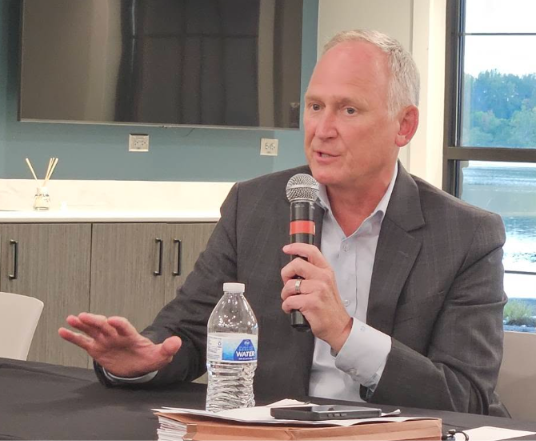
WARSAW — A trio of top Republican state lawmakers unveiled a plan on Tuesday in Warsaw to revamp the state’s property tax system by using local income tax money to cover all of the homestead property tax credit.
The plan would be phased in over five years and only affect tax bills involving a person’s primary residence. It would rely heavily on counties to increase the local income tax to cover expenses for all taxing units.
The proposal was pitched by State Sen. Ryan Mishler along with State Rep. Craig Snow of Warsaw and State Senator Chris Garton, who is expected to become the Senate leader when lawmakers convene in January and begin working on a two-year budget.
Mishler compared his plan to another touted earlier this summer in Warsaw that would eliminate all property taxes and replace it with a sales-on-service tax. He said eliminating all property taxes isn’t realistic because of the $54 billion dollars in local debt covered by statewide revenue.
“So you start with a 20 percent credit on your homestead and over five years you phase it in so you get up to 100 percent,” Mishler told the crowd of several hundred people crowded into the Zimmer Biomet Center Lake Pavilion to hear the plan.
The town hall attracted about a dozen state lawmakers from the region and media from Indianapolis in anticipation of what could become a centerpiece of conversation concerning property tax reform.
Mishler gave an example of Kosciusko County needing to cover more than $40 million in homestead property tax credits. He said all but 14 counties currently have the capacity to cover that full amount and that those counties will reach that opportunity over time under current reforms.
“So this county would have to decide if we want to raise the local income tax enough to cover the $41 million,” Mishler said.
“This is schools, libraries cities, counties … they would have to decide, do we want to raise it enough (to cover costs) or do we want to raise bit a little and try to cut back some things,” he said.
“It really gives the locals the ability to make that decision. It’s their money. It’s their decision to make, and it’s already there. So we don’t need to do anything legislatively to allow them to raise the local income tax,” he said.
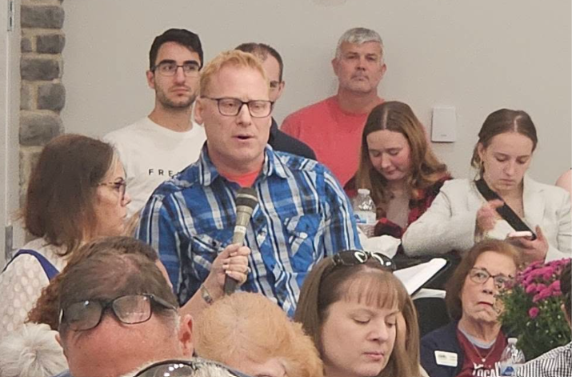
The audience was given a chance to respond to the plan after the presentation by the three lawmakers, and many questioned the impact on various groups such as the elderly, young adults and renters.
Some urged local leaders to tighten their budgetary belts.
“When the state has excess revenue, why aren’t you kicking some of that revenue back to the counties?” asked Mike Felker, of Warsaw. “It’s public money.”
Garten agreed with Felker’s sentiment and said local budgets need to be scrutinized
“If I’m a taxpayer, I think anyone here who is a local elected official should have to justify why you need more money out of my pocket. That’s the case you make to your taxpayers,” Garten said.
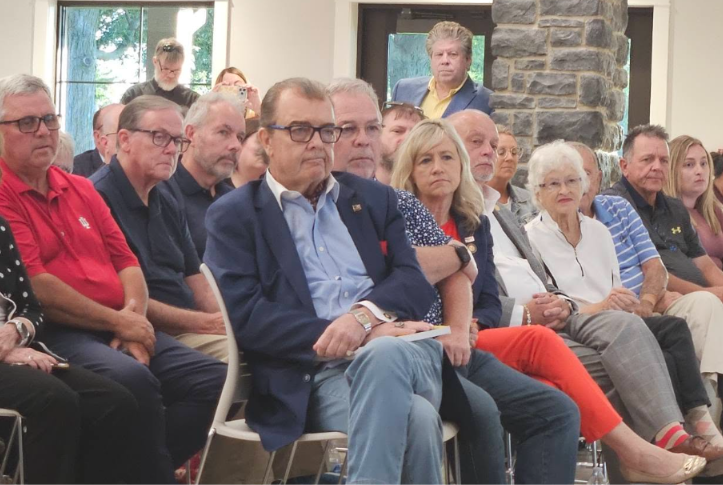
 Others sounded a bit skeptical about the plan put forth Tuesday.
Sue Ann Mitchell, a Kosciusko County Commissioner who has more than four decades of county government experience, said she appreciated the presentation and the lawmakers’ efforts to pitch it at a local level.
She also attended State Rep. JD Prescott’s presentation in Warsaw earlier this year that touted the elimination of all property taxes in favor of a tax on services.
She sounded equally worried about Mishler’s approach.
“If you’re only shifting, you’re still paying,” Mitchell said. “So if we’re going to just take it from a property tax and make it be an income tax without any further adjustments, it’s smoke and mirrors — and that’s not what the people want,” Mitchell said after the meeting.
Mishler’s plan would have to dovetail with changes already underway as a result of SB 1 passed two years ago.
“I think it’s great to get people thinking and talking about it. That part, I agree 100 percent with. But to say you can make long-range plans today before all of the figures and all of the changes in legislation are known is probably not going to be able to happen,” Mitchell said.
John Leavitt, who lives in Nappanee, south of Elkhart, said Tuesday’s discussion about relying on income taxes reminded him of the historic economic downturn that devastated the recreational vehicle industry in Elkhart nearly 20 years ago.
Under a plan that relies on income tax revenue, fewer jobs means less revenue for local leaders to work with.
“If you go back to 2007-2008, we had unemployment at 21%. If you’re relying on income tax to pay all your bills, that’s not a time that’s going to be very fun for anyone, Leavitt said.
Promoting the plan three months before lawmakers start work was a good idea, he said.
“I’m glad they came out to talk with us, and I think that’s a wise thing. These aren’t the sort of things you ought to drop out of the sky,” Leavitt said.
Randy Figg, a former elected official from St. Joseph County, said raising the income tax would be a hard sell to local government leaders, and expressed concern about the impact the transition could have on smaller units of government.
“That would require us in the County Council in St. Joe County to raise taxes on our citizens,” Figg said. “It’s a nice idea, but I’d have to see how it’s laid out, and you’re talking about the fire department, you’re talking about library — everybody on the levy … but I’d be willing to sit down and look at it. That’s a tough pill to swallow as an elected official.”
Kosciusko County Councilman Joe Irwin attended the meeting and said he was looking forward to seeing some kind of change, but was unsure what kind of plan he would support.
He said the county is struggling to adjust to policy changes already underway.
“We have to deal with whatever they come up with, and we will,” Irwin said.
“Obviously, we all would have liked to have had it organized better from the beginning because right now, there’s a lot of confusion about what’s going on. So it makes it hard for us as a county and everybody involved to budget,” Irwin said.
Two of the lawmakers were especially critical of Baker Tilly, a financial consulting firm that works with a large majority of cities and counties in the state.
The city of Warsaw has contracted with the company for more than ten years while Kosciusko County relies on another firm hired just a few years ago.
Garten and Snow lamented how a large majority of cities and towns rely on Baker Tilly Financial Services for consulting.
Garten contends Baker Tilly created a ‘Chicken Little’ scenario by using calculations that made lawmakers look bad by forecasting a zero percent growth assessment.
The move is intended to force local entities to seek more tax revenue to cover the possible gaps in funding.
“When you calculate with a zero percent growth into all these local budgets, of course it looks terrible,” Garten said.
He continued, saying local units of government feel like they have a moral obligation to believe them and trust what they’re saying.
“The reality is, it’s a bogus product. It’s wrong. And you should fire them today,” he said.
Snow said he’s confronted the company about the practice.
“When you do it in the public sector, it’s egregious, and it’s wrong. And so that’s why I really got bent out of shape, and I just said, ‘you guys have got to stop doing this,’ ” Snow said.
The post Mishler’s proposal would rely on additional income tax to replace homestead tax appeared first on News Now Warsaw.
