
End property taxes? Uncertainty and questions arise at meeting in Warsaw
By Dan Spalding
News Now Warsaw
WARSAW — The notion of Indiana replacing property taxes with a sales tax on services prompted plenty of questions and concerns Friday in Warsaw.
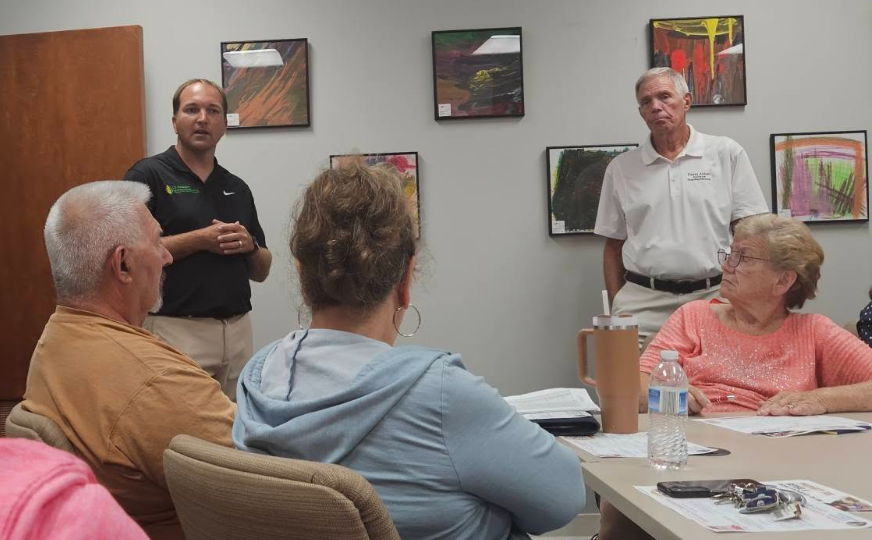
State Rep. J.D. Prescott, author of the legislation, led the discussion and fielded questions for nearly two hours.
State Rep. J.D. Prescott, author of the legislation, led the discussion and fielded questions for nearly two hours.
His plan calls for the phase-out of residential, business, and agricultural property taxes, replacing them with a 7 percent sales tax that would include several exceptions, including one for health care services.
Under his plan, primary residences would no longer be taxed as soon as 2028.
Based on an analysis by the Legislative Services Agency, Prescott projects the sales tax would generate about $13 billion to $15 billion, compared to property taxes that bring in about $11.6 billion.
The additional money collected under the proposed tax would be needed to create a reserve fund that would address anticipated shortfalls during economic downturns when sales revenues typically decline, Prescott said.
One person asked if the transition would tarnish the state’s reputation for having low taxes. Prescott countered by suggesting that it would attract business by becoming the only state to get rid of property taxes.
Ramifications would be extensive if adopted.
The transition would eliminate the use of tax increment finance districts, which have become a key tool for economic development and are relied upon heavily by cities and towns.
Upon passage of the bill, there could be no new debt tied to the property tax system, no new TIF districts and no new school referendum, Prescott said.
The issue would be further complicated by existing agreements for bonding projects financed with TIF dollars that often extend as long as 20 years.
Sales revenues would eventually fill that void, but Prescott said existing agreements could not be negated.
Future economic development would be controlled by cities and counties, and it would be up to them to decide on how much they want to allocate toward economic development from incoming sales tax revenues, he said.
That led to a lengthy discussion about the Indiana Economic Development Corporation, which has been under scrutiny in the past two years over its policies and practices. A regional director for Braun attended the meeting and offered several clarifications on the issue.
More than one person said the state is not doing enough to reform the office and claimed some of the projects are not necessary or appropriate.
Another change: If enacted, county assessor offices, which calculate assessments used for the basis of property taxes, would no longer be needed.Still unresolved is how townships would be handled, Prescott said.
Many of those asking questions Friday were county officeholders.
Two elected officials with Fulton County said such a quick transition would present a complicated scenario on top of challenges happening under the current policy shift.
While Prescott’s plan was met with many questions, sentiment over the existing system was a continuing theme, with some saying spending practices need to be reviewed by a localized version of the federal government’s short-lived program known as the Department of Government Efficiency (DOGE).
Some at the meeting found the opportunity to consider a rehaul of the tax system to be refreshing.
Kosciusko County Councilman Wil Stockdale attended the meeting. He is among many who dislike the fact that property taxes continue after mortgages are paid off.
“We don’t want to rent from the government, so getting rid of property taxes entirely, if it’s economically feasible, is a cool idea,” Stockdale told Prescott.
“I just want you to know that we do really appreciate you being here, for all the heat that you take, for having ideas, because obviously the system is not working right now,: Stockdale said.
“Anything is probably a step in the right direction unless it’s just absolutely bonkers,” he said.
Kosciusko County Commissioner Sue Ann Mitchell, who has worked in county and township government her entire adult life, attended the meeting. Afterward, she cautioned against moving too quickly.
“I believe they need to take a step back, they need to breathe,” Mitchell said.
“We hurried in (2025) into Senate Bill 1, and then we tried to straighten it out in ‘26 — and it’s still not straightened out — and here we are in ‘27 with yet another different plan,” Mitchell said.
“I believe that they need to take a breath, figure out what they’re doing wrong … and have some certainty that what you’re doing is right, instead of all the what-ifs,” Mitchell said.
She said the plan should be sent to a legislative study committee for a review.
Prescott voted for Braun’s property tax reform, and said at the time that it was not enough.
“We got as much as we could do. I voted for it because it did slow down the bleeding in some cases, but I said at the beginning it was just a band-aid to a larger problem that we need to address,” Prescott said.
“We need to have a long-term solution and not just nibble around the edges,” he said.
Asked if there was a sense of urgency in addressing the issue, he replied:
“I want to fix the system. I want to quit playing around with these band-aids, just treating symptoms and treat the underlying disease.”
Prescott’s meeting was organized in part by Republican State Reps. Dave Abbott and Craig Snow. Abbott attended, but Snow was unable due to a prior commitment. Neither Abbott nor Snow have endorsed the concept.
No Kosciusko Chamber officials attended the meeting. While numerous county officials attended, it did not appear anyone representing the city of Warsaw was there.
The meeting is part of a series across the state being held by Prescott.
Plans for Friday’s meeting came to light locally on Wednesday.
Prescott’s bill could end up competing next year with another plan proposed by State Sen. Ryan Mishler, who wants to eliminate the homestead tax.
A public meeting about that plan is scheduled for Sept. 29 at the Zimmer Biomet Center Lake Pavilion in Warsaw and will be hosted by Mishler and Snow.
The post End property taxes? Uncertainty and questions arise at meeting in Warsaw appeared first on News Now Warsaw.